The Line Up
The Three Stooges were never just one trio. The act kept its shape while the third chair changed the rhythm.
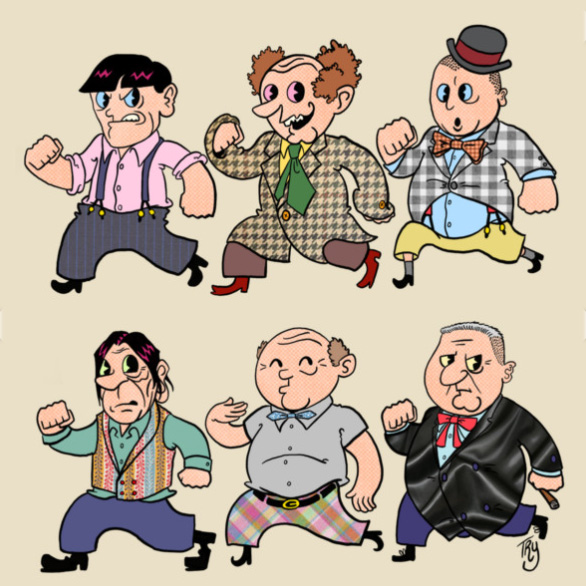
A cartoon roll call of the six main Stooges across the act's long, strange run.
The Stooges look simple from a distance: Moe, Larry, and a third man caught in the blast radius. Up close, the lineup is the story. The act begins in vaudeville orbit around Ted Healy, hardens into the Columbia shorts with Curly, then survives its biggest shock when Shemp comes back after Curly's illness.
Shemp: Vaudeville
Shemp Howard was the original third Stooge in the stage act. Before the Columbia shorts made the trio a film institution, Shemp helped define the early chemistry: Moe as the boss, Larry as the scrambled middle, Shemp as the jittery, reactive comic with a nervous edge.
Curly: Movies
When Shemp left to pursue solo work, Curly Howard stepped in. That substitution changed everything. Curly's childlike energy, barking noises, floor spins, and sudden eruptions gave the Columbia shorts their most famous form. For many viewers, Curly is the sound of the Stooges arriving at full speed.
Shemp Returns
Curly suffered a stroke in 1946, and the act had to solve an impossible problem: how to remain the Stooges without the performer who had become their wildest center. Shemp returned, this time for the movies, and the comedy shifted. The pace stayed rough and physical, but Shemp brought a more verbal, anxious, sideways timing.
The Same Shape, A New Beat
The Shemp return is not just a replacement story. It proves the Stooges were a structure as much as a cast list: Moe's authority, Larry's baffled counterweight, and a third Stooge who could bend the chaos into a different kind of music. Curly made it explosive. Shemp made it twitchy, crafty, and strange.
After the Big Transition
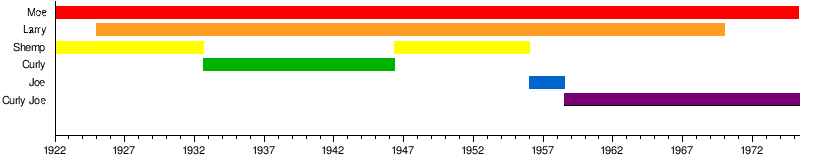
A compact view of the Stooges lineup changes, from the vaudeville years into the movie and television eras.
The later lineup changes continued the pattern. Joe Besser followed Shemp in the final Columbia shorts, and Curly Joe DeRita joined Moe and Larry for the feature-film and television period. Those later versions matter, but the central hinge of the Stooges story is the Shemp to Curly to Shemp passage: stage act, movie explosion, and survival after Curly.