Columbia Shorts
The Stooges did their most famous work inside Columbia Pictures' short-subject machine, where cheap sets, hard deadlines, and violent precision turned three comic bodies into a factory of beautiful nonsense.
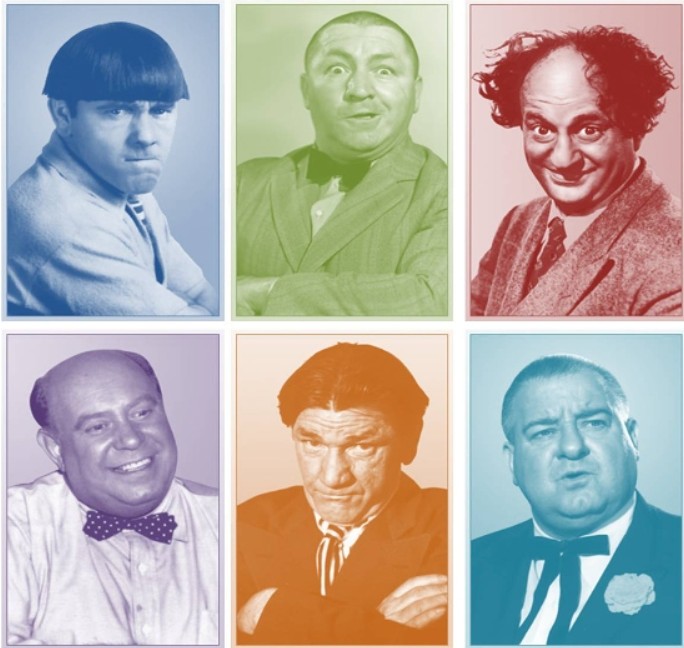
The six principal Stooges: (top) Moe Howard, Curly Howard, Larry Fine. (bottom) Joe Besser, Shemp Howard, and Curly Joe DeRita.
The Act
The Stooges are built like a machine with three moving parts. Moe supplies command and punishment. Larry supplies baffled resistance. The third Stooge supplies the unstable comic fuel: Shemp's nerves, Curly's eruptions, Joe's fussiness, or Curly Joe's late-era warmth.
That structure is why the act could survive cast changes. The faces changed, but the pressure system stayed familiar: authority, confusion, revolt, impact.
The Columbia Machine
At Columbia, the Stooges worked in a short-subject format that rewarded speed. Plots were simple, sets were reused, and the joke density had to be high. A courtroom, a kitchen, a hotel room, a haunted house, or a repair job could become a percussion instrument.
The result was not elegance. It was rhythm. Every poke, slap, door slam, pratfall, and insult arrived as part of a blunt comic beat.
Curly and Shemp
Curly Howard made the Columbia shorts explode. His comedy was physical, musical, and weirdly innocent: barks, spins, dropped posture, sudden panic, and the feeling that language itself had been knocked loose.
When Curly's health failed in 1946, Shemp Howard returned. The shift matters. Shemp was not a Curly copy, and the best Shemp shorts do not ask him to be one. His timing is more anxious, verbal, and crooked. Curly turns chaos into weather. Shemp turns it into suspicion.
The Later Lineups
After Shemp, the Columbia shorts moved into the Joe Besser period, then the broader public afterlife continued with Curly Joe DeRita in feature films and television appearances. Moe and Larry remained the through-line, carrying the shape of the act into a different entertainment landscape.
The later lineups are sometimes treated as footnotes, but they show how durable the brand had become. By then, "The Three Stooges" was not just a lineup. It was a recognizable comic grammar.
Cartoon Violence in Human Form
The Stooges' violence works because it behaves more like animation than realism. The eye-poke is a punctuation mark. The head bonk is a cymbal crash. The slap is not just pain; it is a scene edit with fingers.
That is the secret of the Columbia shorts. They are not stories about sensible adults. They are cartoons temporarily trapped in human bodies, moving through a world where every object is waiting to become a weapon, a tool, or a punchline.