Stooges Central
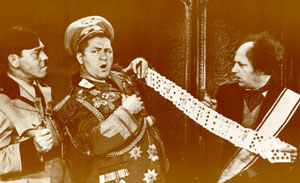
The Stooges turn menace into machinery: panic, uniforms, props, timing, and one impossible sleeve.
The Three Stooges began as a vaudeville collision and became one of the most durable comic machines in American film. Their world is built from blunt instruments, sudden entrances, bad ideas, worse plans, and the sacred dramatic principle that a ladder is never just a ladder.
The classic screen lineup -- Moe Howard, Larry Fine, and Curly Howard -- gave the act its most instantly recognizable shape. Moe drove the chaos with tyrannical precision, Larry absorbed it with frizzy bewilderment, and Curly transformed panic into music: barks, whoops, spins, floor work, and pure elastic nonsense. When Curly's health failed, Shemp Howard returned and gave the shorts a different rhythm, sharper and slyer but still unmistakably Stooges.
At Columbia Pictures, the Stooges turned short subjects into a kind of industrial slapstick: fast, cheap, loud, and weirdly exact. The plots often barely matter. What matters is the rhythm -- an insult, a misunderstanding, a poke, a crash, a chorus of injured dignity -- repeated until the whole scene becomes percussion.
Their afterlife may be the strangest part. The shorts were made for theater programs, then found a second kingdom on television, where kids encountered them as if they had always existed. The names changed around the edges -- Curly, Shemp, Joe, Curly Joe -- but the central spell stayed intact. Three figures enter a room. Order loses. Comedy wins by force.
Around the edges of the Stooges story sit some neighbours worth a visit. The act grew up on the vaudeville stage with Ted Healy and His Stooges, then joined a comedy parade that included Laurel and Hardy, the Marx Brothers and Charlie Chaplin, whose The Great Dictator arrived in 1940, the very year the Stooges aimed their own broad comedy at big evil. Their pie-slinging classic In the Sweet Pie and Pie has descendants: the cafeteria riot in National Lampoon's Animal House and, over in the arcade, Food Fight -- and the trio even got a cabinet of their own, The Three Stooges in Brides Is Brides. Another famous duo wandered into a horror classic the same decade the Stooges peaked: Abbott and Costello Meet Frankenstein.
From the Cast Data
The local Stooges timeline tracks 282 entries, including 226 main Three Stooges records, Shemp solo films, lineup changes, anti-Nazi shorts, Columbia releases, and later feature-film appearances.
The Moving Third Chair
Moe and Larry anchor the act across eras. The third Stooge becomes the story engine: Shemp in the early Healy years, Curly during the golden Columbia run, Shemp again after Curly's stroke, then Joe Besser and Curly Joe DeRita in the later period.
Classic Lineup
Moe Howard is marked as "The Boss Stooge," Larry Fine as "The Fiddle Player," and Curly Howard as "The Beloved Stooge." The data notes Curly's "nyuk nyuk nyuk," woo-woo spins, and childlike energy as the defining charge of the golden era.
Wartime Stooges
The dataset singles out anti-Nazi films including You Nazty Spy! in 1940, I'll Never Heil Again in 1941, and Back From The Front in 1943. The hero image fits that sharp little corner of Stooges history: broad comedy aimed straight at big evil.