Times Square
is one of the most iconic locations in New York City, known for its bright lights, Broadway theaters, and bustling atmosphere. This timeline explores the history of Times Square from its origins as Longacre Square in the 1890s to its transformation into a global tourist destination in the 21st century.
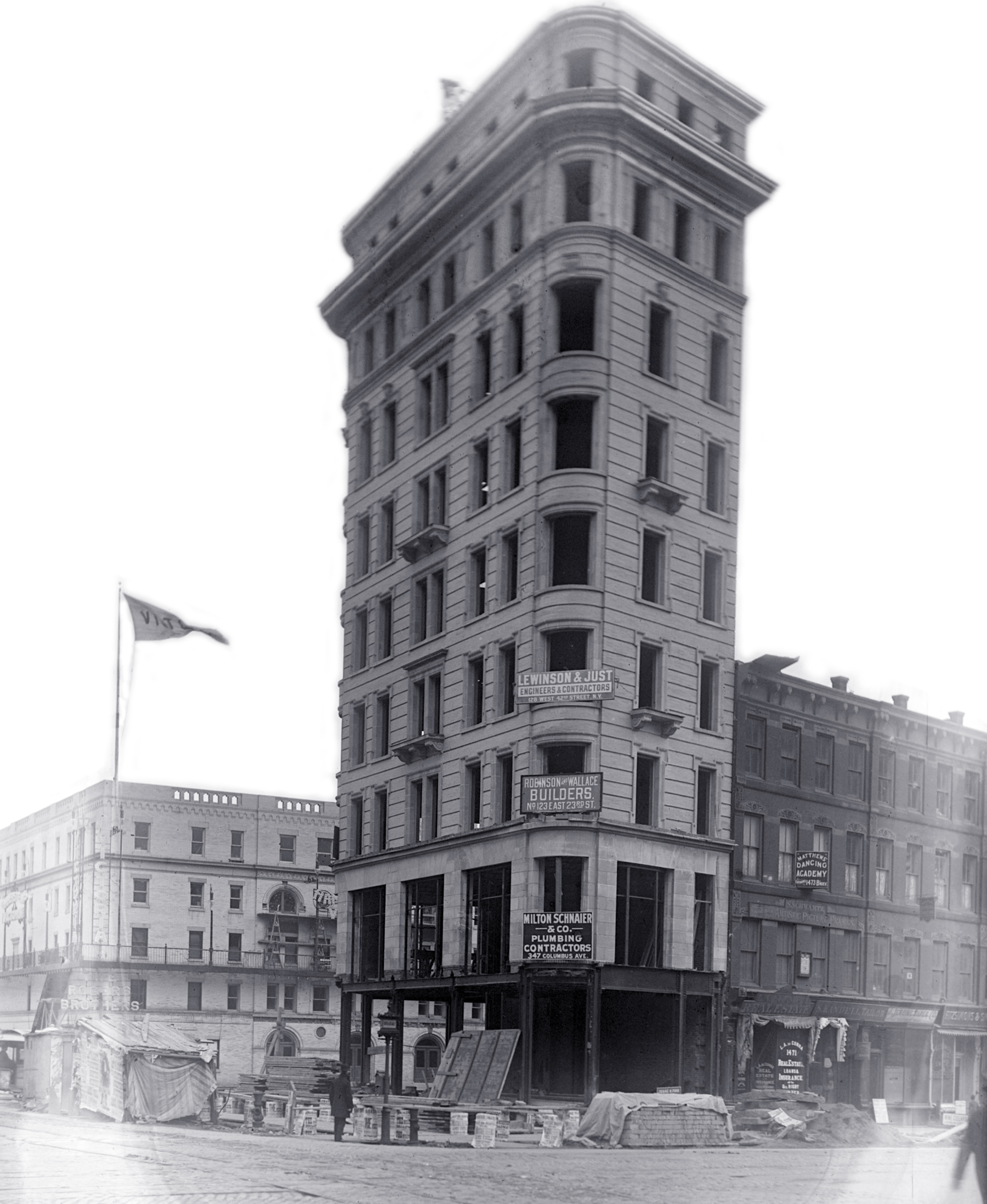
1890s
Before Times Square became the iconic destination we know today, the area was known as Longacre Square, named after London's carriage district. In the 1880s, this was primarily an area for the carriage trade, with horse stables and blacksmith shops.During the 1890s, the area began its transformation from a district of horse stables to an entertainment center. Oscar Hammerstein built the Olympia Theatre on Longacre Square in 1895, helping to establish the area as an entertainment district.
By the late 1890s, the area was becoming New York's theater district as venues began moving uptown from Union Square and Madison Square.
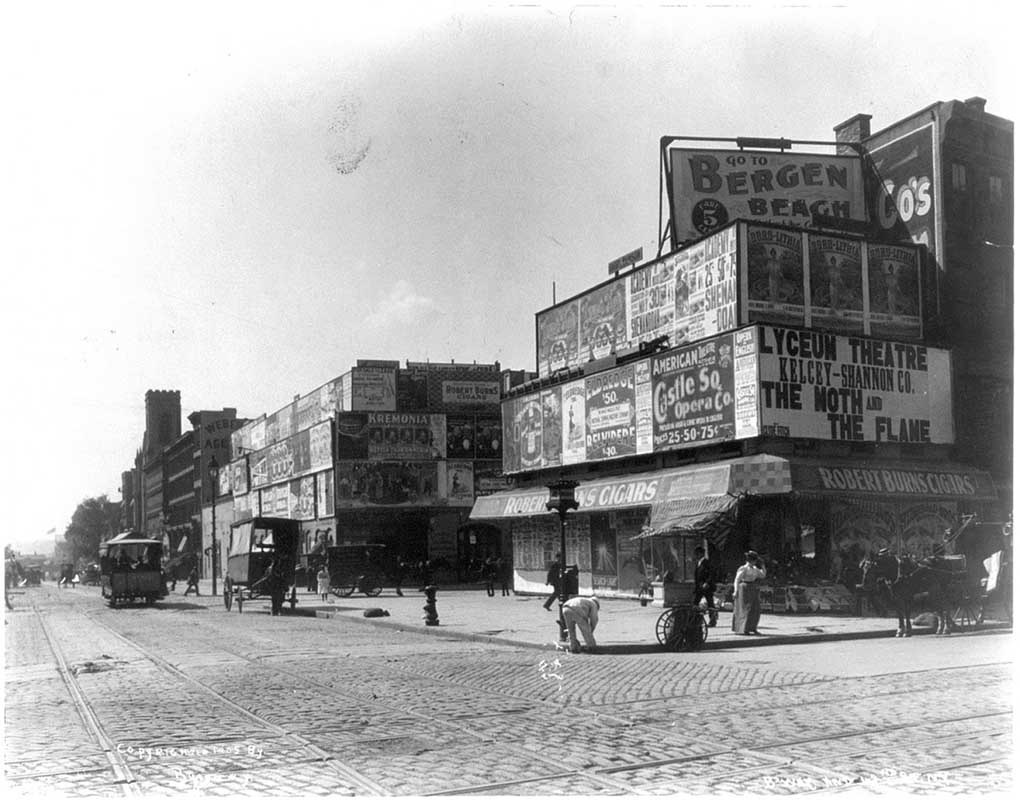
Early photograph of Times Square (1898)
Long Acre Square before being renamed to Times Square, showing the early development of the area.
1900s
The pivotal moment in Times Square history came in 1904 when The New York Times moved its headquarters to the newly built Times Tower at the intersection of Broadway and 42nd Street.
On April 8, 1904, Mayor George B. McClellan, Jr. officially renamed Longacre Square to Times Square in honor of The New York Times.
The first New Year's Eve celebration in Times Square was held on December 31, 1904, marking the official opening of the new Times headquarters.
In 1907, the tradition of the New Year's Eve Ball Drop began when The New York Times' owner Adolph Ochs commissioned a time ball to be lowered from the flagpole atop Times Tower.
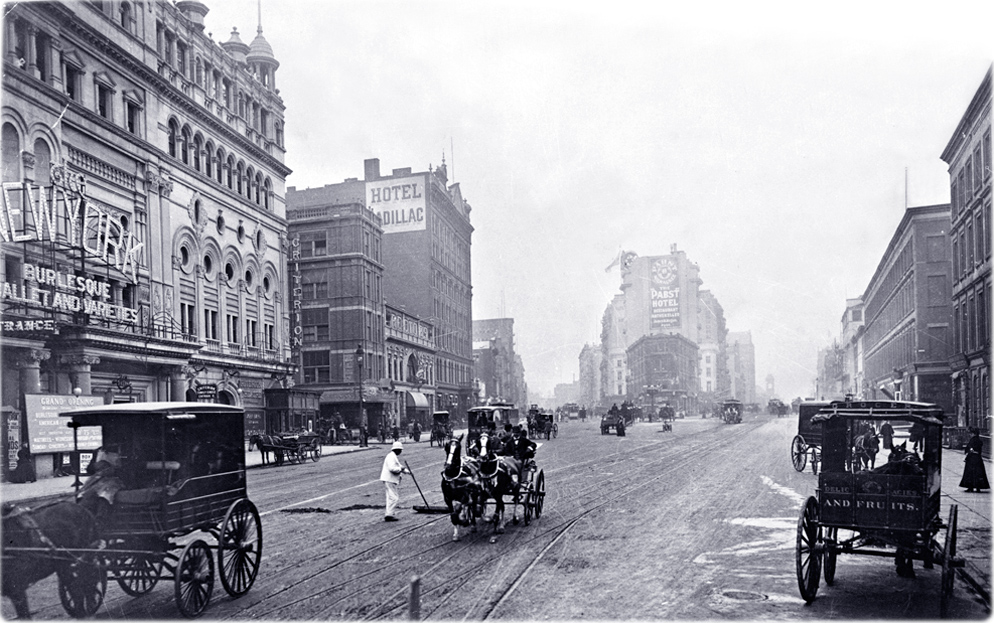
Early photograph of Times Square (1900)
Long Acre Square looking south from 45th Street, before being renamed Times Square.
Early photograph of Times Square (1898)
Long Acre view from the Library of Congress collection of New York City.
1910s
During this decade, Times Square solidified its reputation as the center of New York's theater district, with many Broadway theaters opening in the area. The "Great White Way" nickname for Broadway became popular, referring to the bright lights and electric signs that illuminated the theater district. In 1913, the Palace Theatre opened and became the premier vaudeville house in America. World War I brought crowds to Times Square for news updates, which were displayed on the Times Tower.
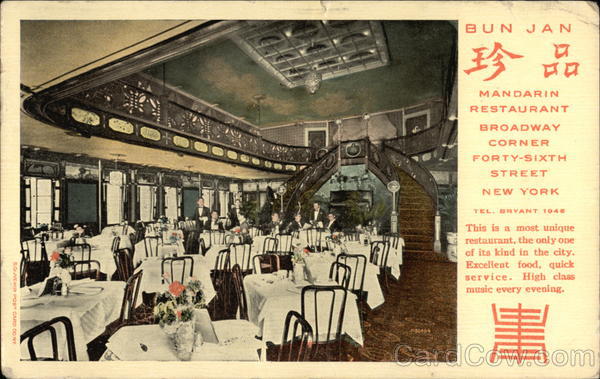
Rare shot of Bun Jan Mandarin Restaurant (1914)
Bun Jan Mandarin Restaurant above Child's (1912-1959) at 1551 Broadway.
1920s
The Roaring Twenties saw Times Square reach new heights of glamour and decadence. The area became synonymous with Jazz Age entertainment and nightlife. In 1927, the Paramount Building and Theatre opened, becoming one of the grandest movie palaces of the era. Ziegfeld Follies, elaborate theatrical revues, were at the height of their popularity, contributing to Times Square's reputation for spectacle and glamour. The I. Miller Building (1926) showcased statues of famous actresses, celebrating theater culture.
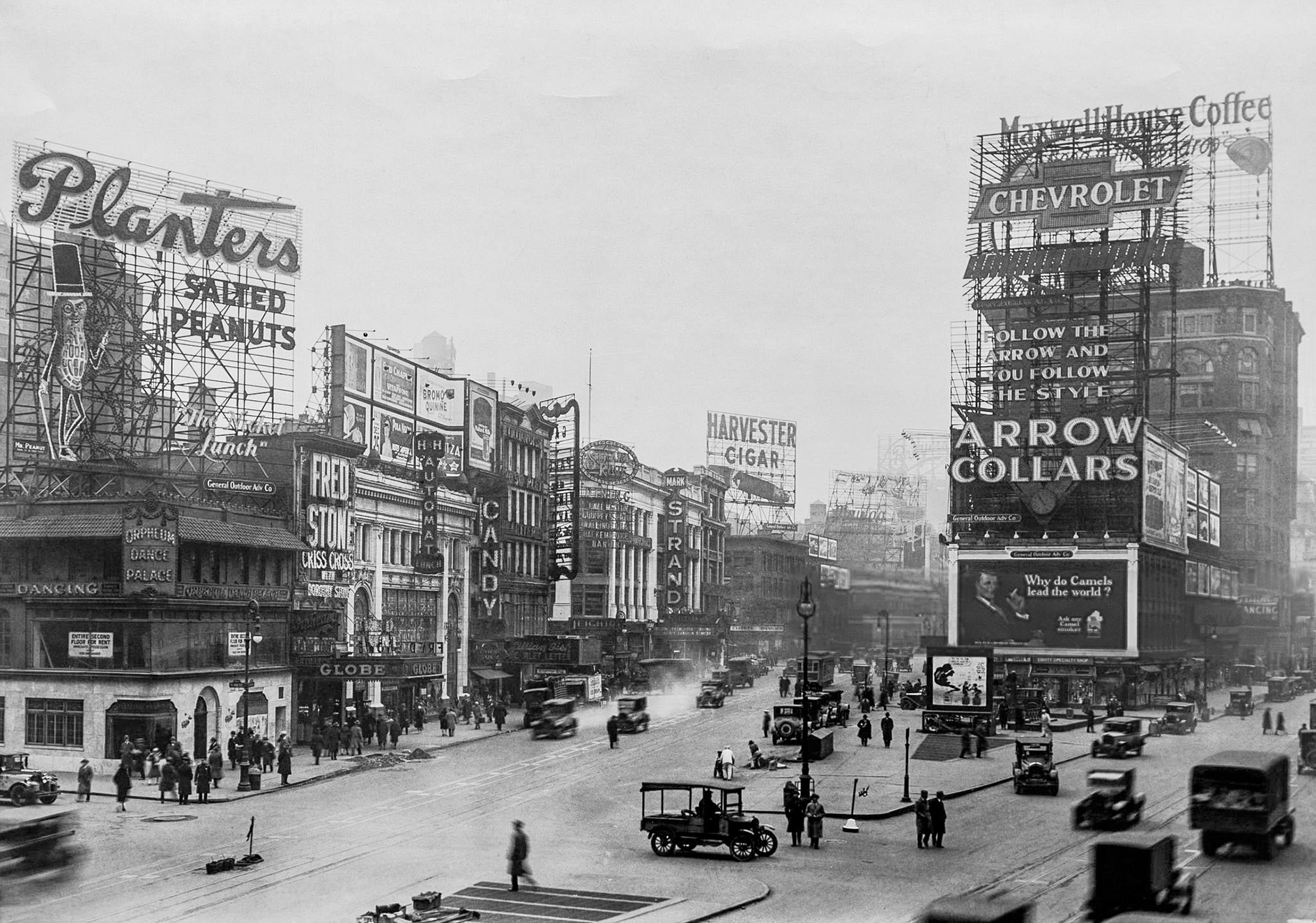
Times Square (circa 1926)
Early photograph of Times Square featuring Mr. Peanuts Nickle Lunch sign.
1930s
The Great Depression brought changes to Times Square, with many theaters struggling financially. Some converted to movie houses or burlesque theaters to survive.
Despite economic hardship, Times Square remained a center for entertainment and escapism during difficult times.
In 1934, the Lyric Theatre (later demolished and rebuilt) presented "The Black Crook," considered the first American musical.
The International Casino opened in 1937, becoming one of the area's most popular nightclubs.

View from McGraw-Hill building (October 9, 1931)
Samuel H. Gottscho - Midtown Manhattan view from McGraw-Hill building, New York.
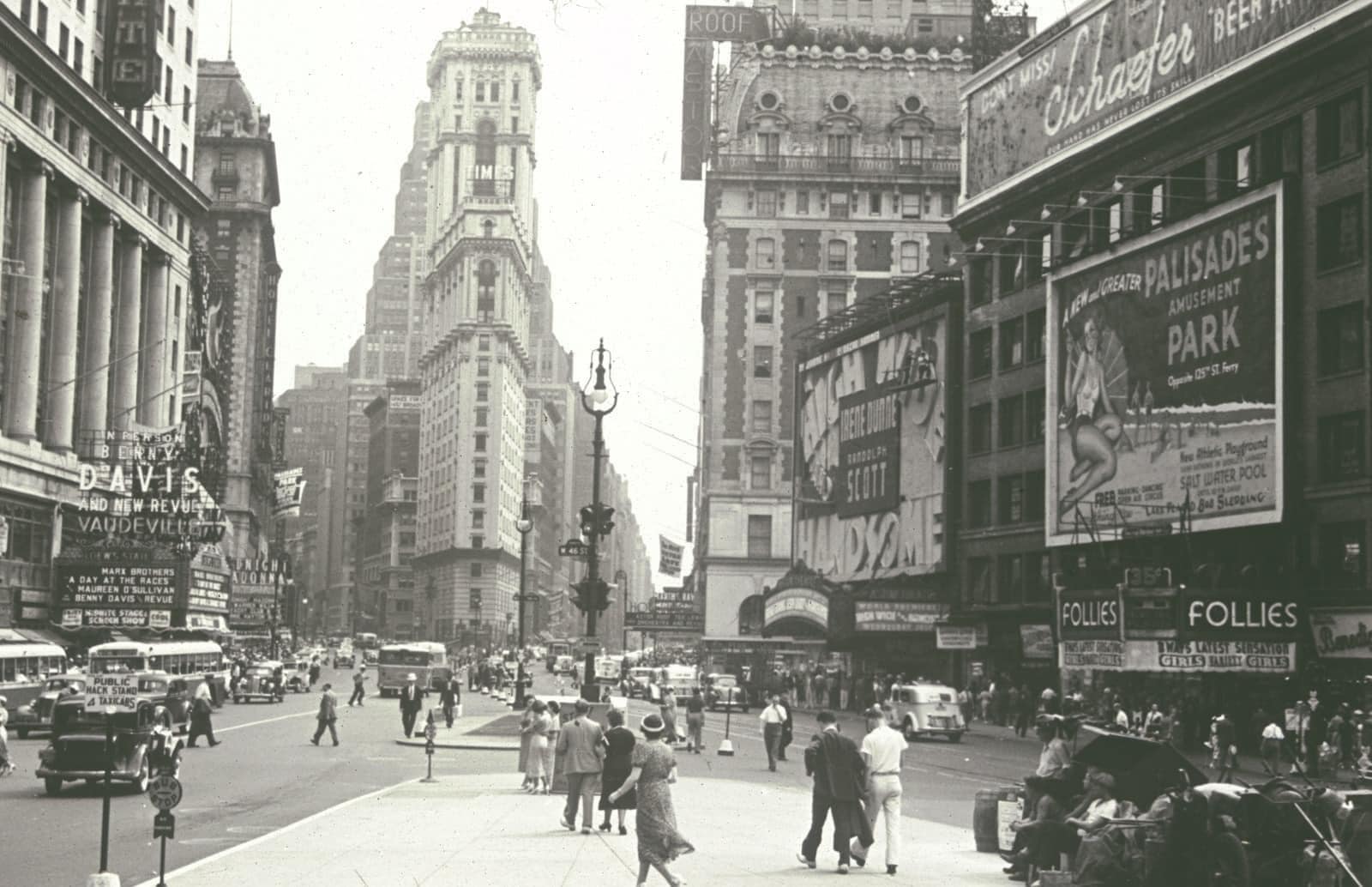
Times Square ( 1937)
Crowded sidewalks in front of the huge advertisment for Palisades Park.
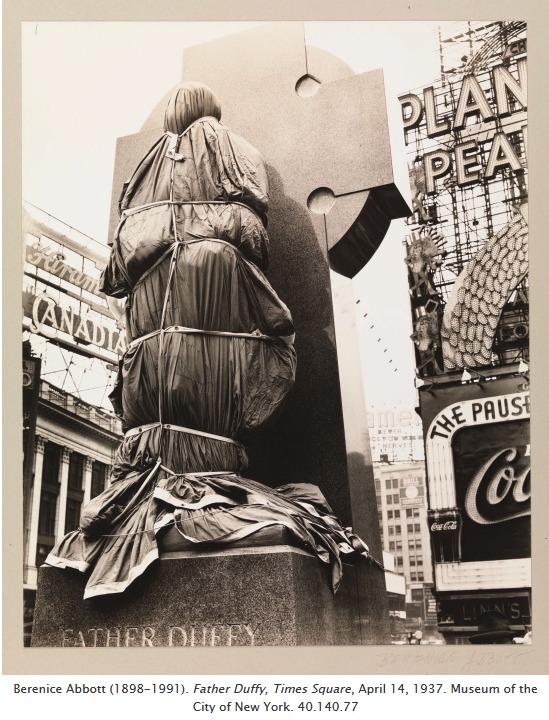
Father Duffy statue unveiling (1937)
Before the unveiling of the Father Duffy statue in Times Square.
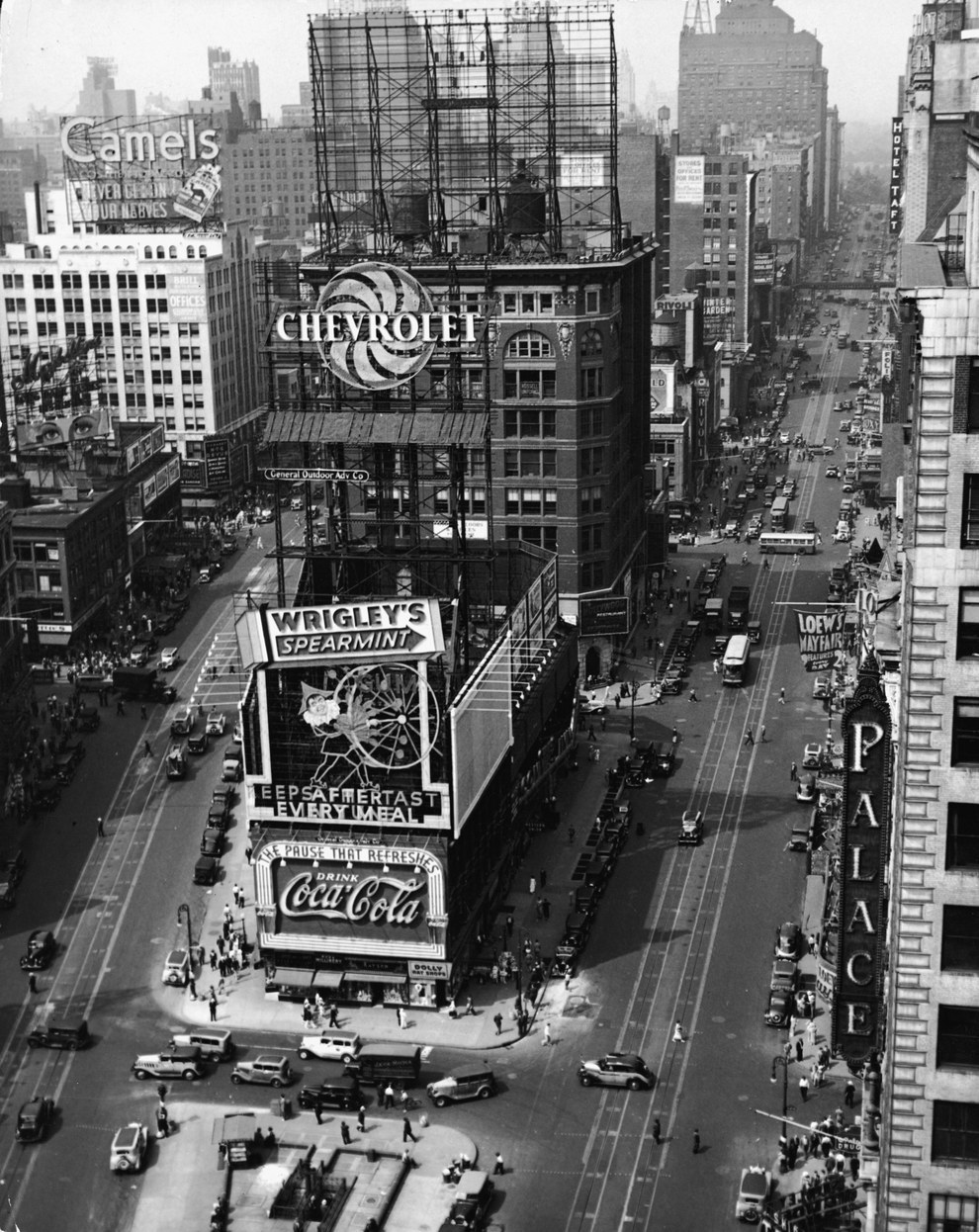
Aerial view of Times Square (1935)
Great view of the "North Stack" of towering signs -- featuring Chevy, Wrigleys and more. Photo credit: Getty/Frederic Lewis.
1940s
World War II transformed Times Square into a hub for servicemen on leave, with the iconic photograph of the V-J Day kiss taken here in 1945 by Alfred Eisenstaedt. The area became known for its "Crossroads of the World" nickname during this period as soldiers from around the country gathered there. In 1947, the famous "Camel Man" billboard with its smoke ring-blowing mechanism was installed, becoming one of Times Square's most recognizable advertising features.
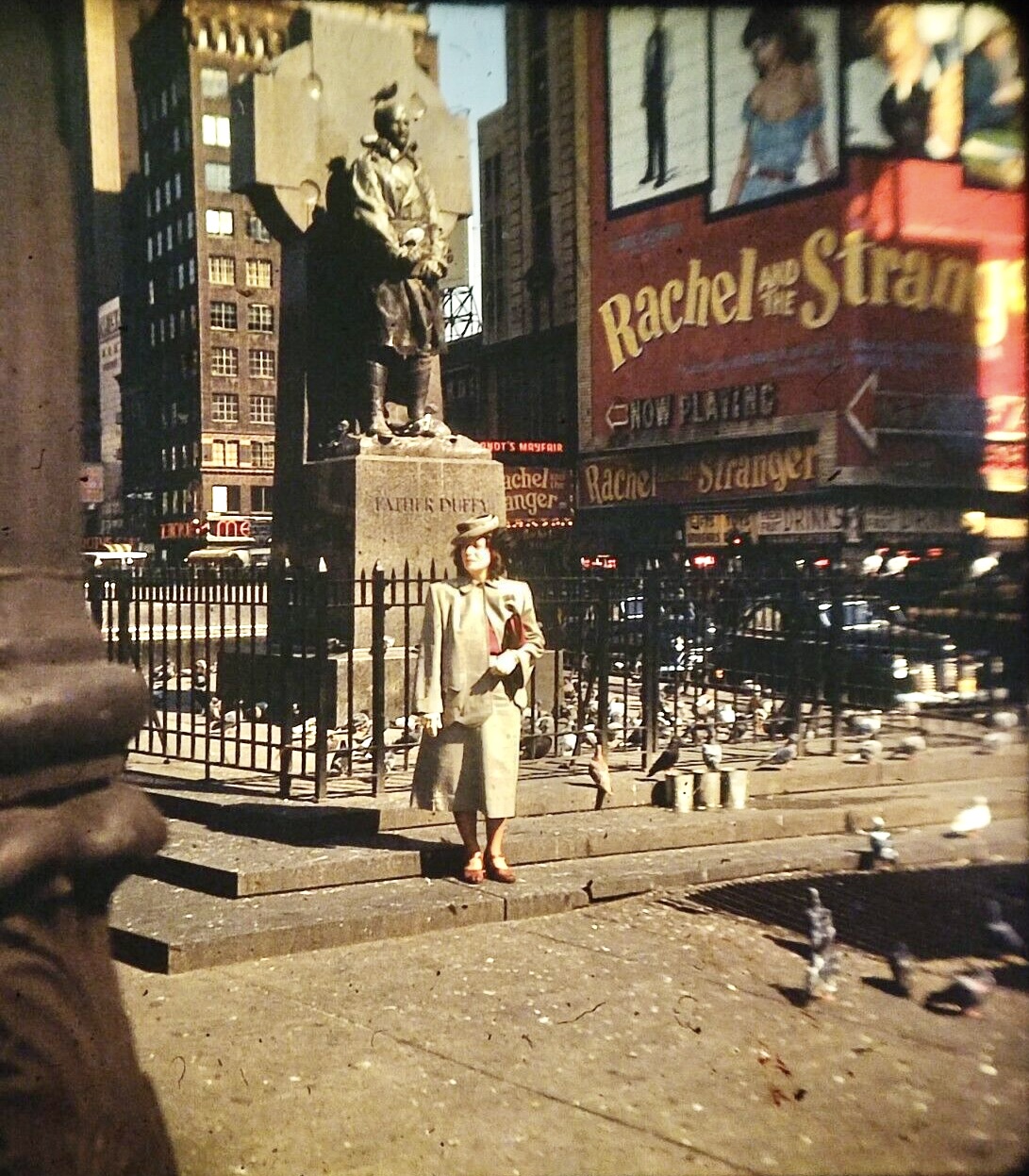
Duffy Square (1948)
Woman poses in Duffy Square, 1948 . Movie poster for "Rachel and the Stranger" visible.
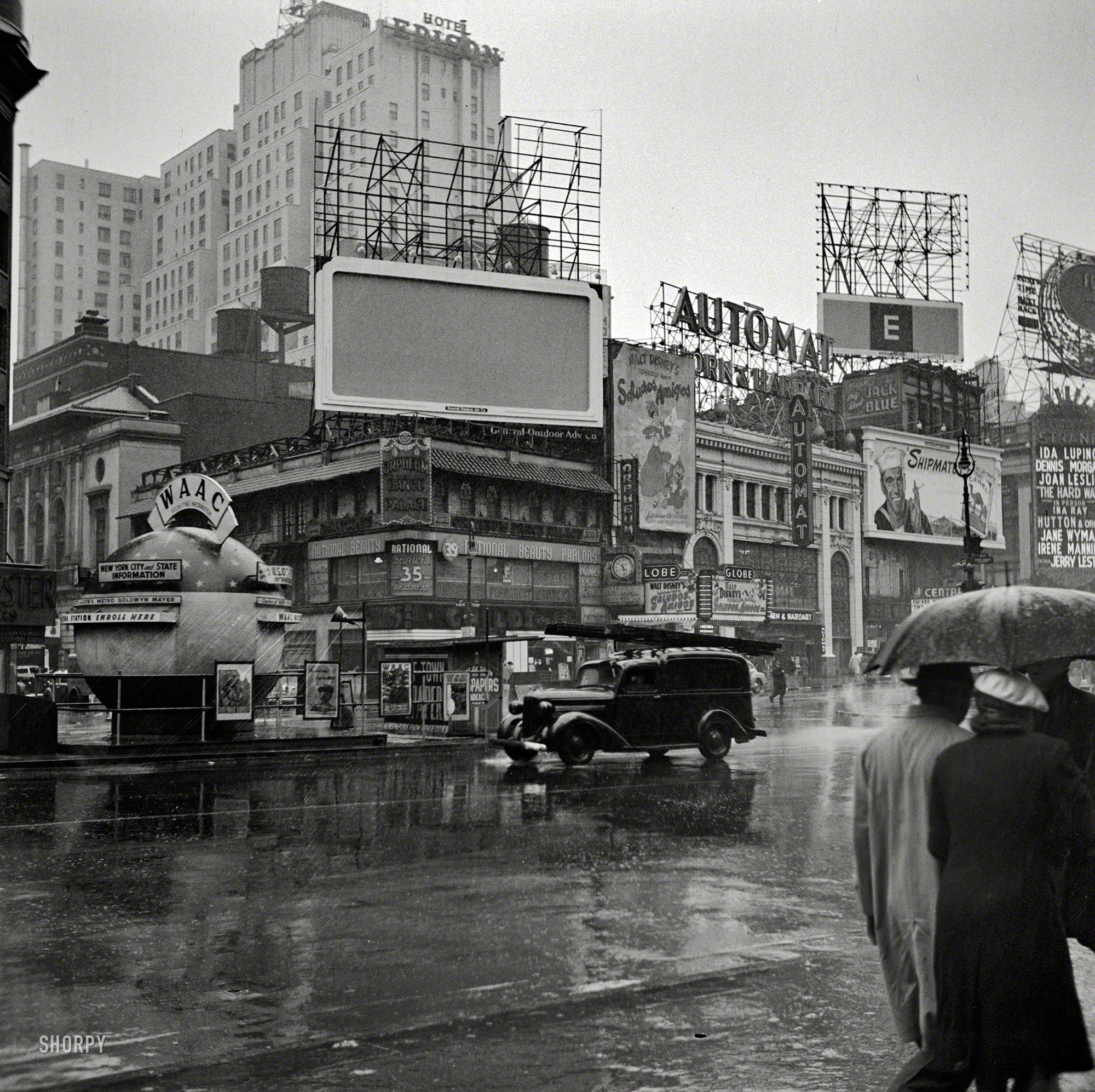
Rainy day in Times Square (1943)
Movie poster for Walt Disney's "Saludos Amigos" visible over the Globe Theatre.
1950s
The 1950s marked a transition period for Times Square, with television beginning to compete with theaters for entertainment supremacy. In 1952, the film "Baby Doll" premiere at the Victoria Theater caused controversy with its provocative billboard. The Lunt-Fontanne Theatre (formerly Globe Theatre) was renovated in 1958 and renamed after the famous acting couple Alfred Lunt and Lynn Fontanne. The first electronic news ticker was installed on the Times Tower in 1951, displaying headlines to passersby.
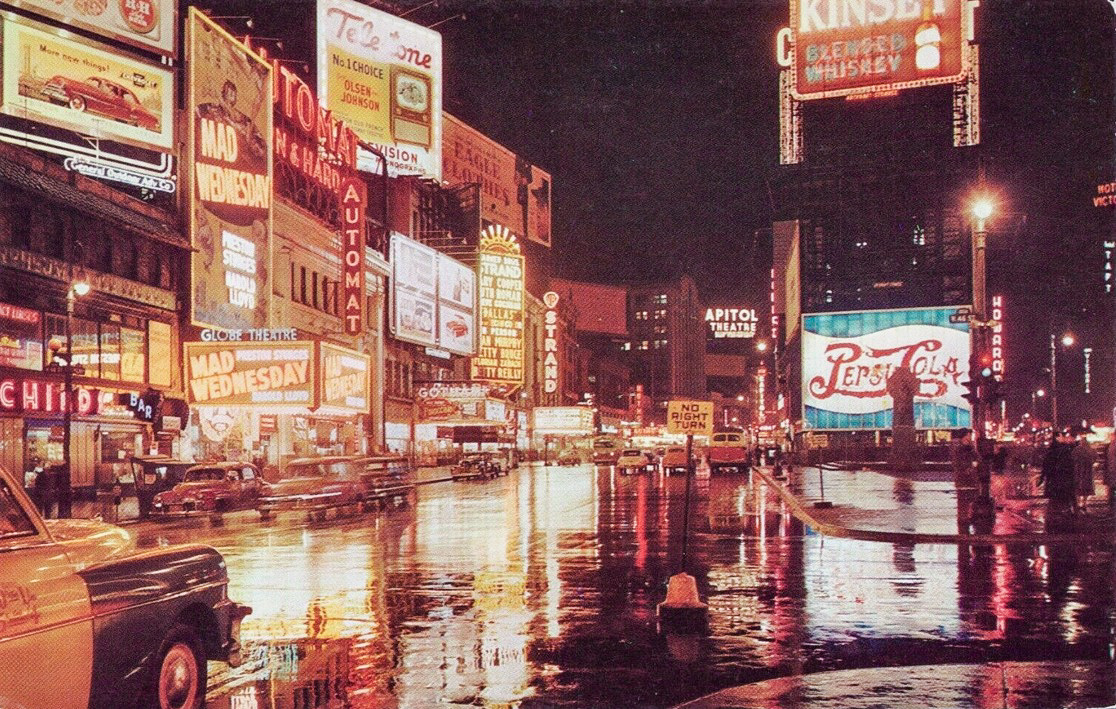
Rainy Night in Times Square (1950)
A rain-soaked evening on Broadway, neon reflections shimmering off wet pavement as traffic rolls past the Pepsi sign and the marquee for "Mad Wednesday."

Al Capone at Victoria Theatre (circa 1959)
Al Capone movie showing at Victoria. Burnt out buildings left of Loew's State Theatre about to be demolished.
1960s
Times Square began to experience decline during the 1960s, with increasing crime rates and the rise of adult entertainment venues. The original Times Tower was significantly altered in 1963, stripped of its ornate façade and reclad in marble, fundamentally changing the appearance of Times Square's central building. Traditional Broadway theaters struggled amid changing entertainment tastes, though musical theater innovations like "Hair" (1968) brought new energy to the district.
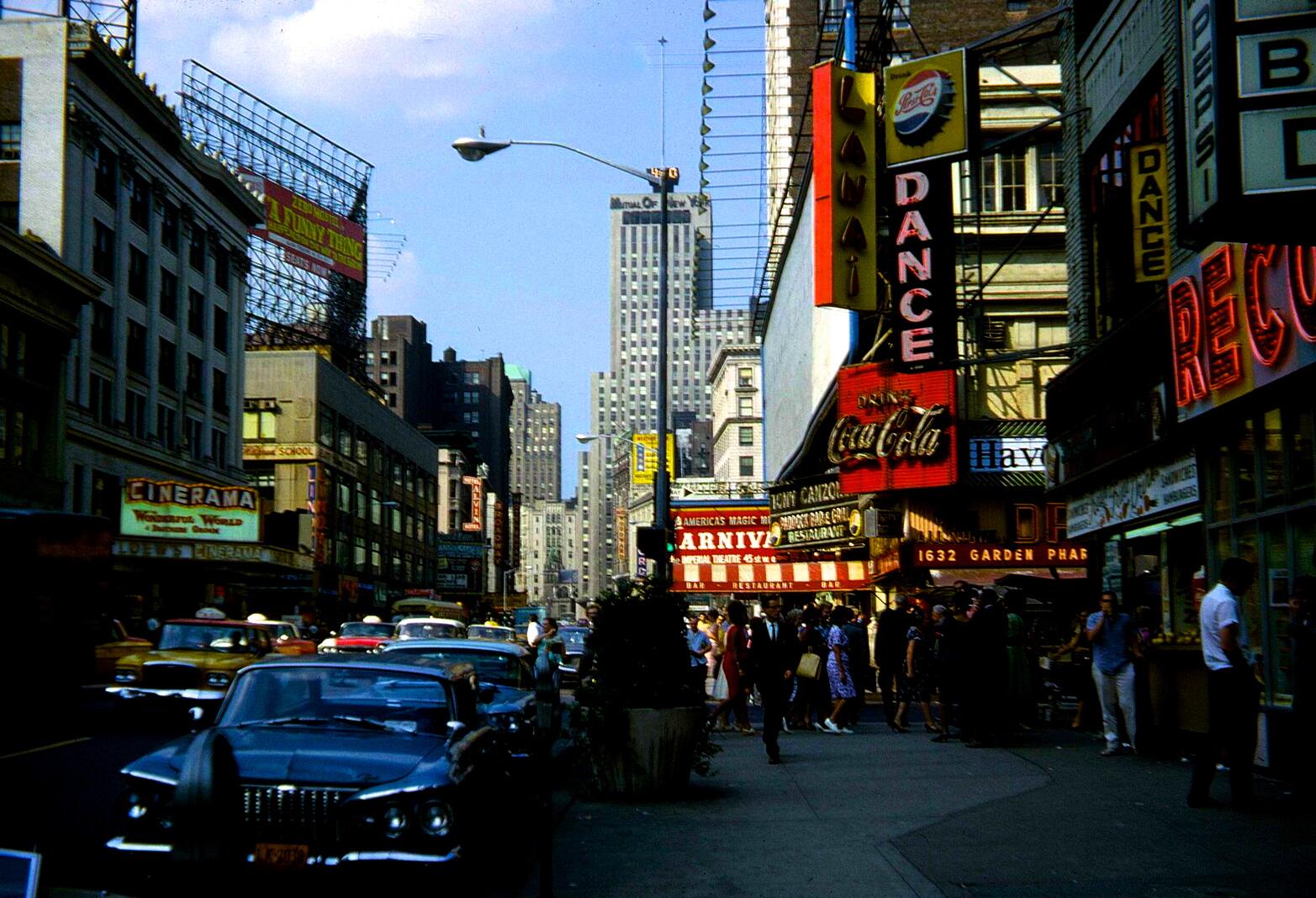
Forum Carnival scene (1962)
Broadway view of Forum Carnival scene in 1962.
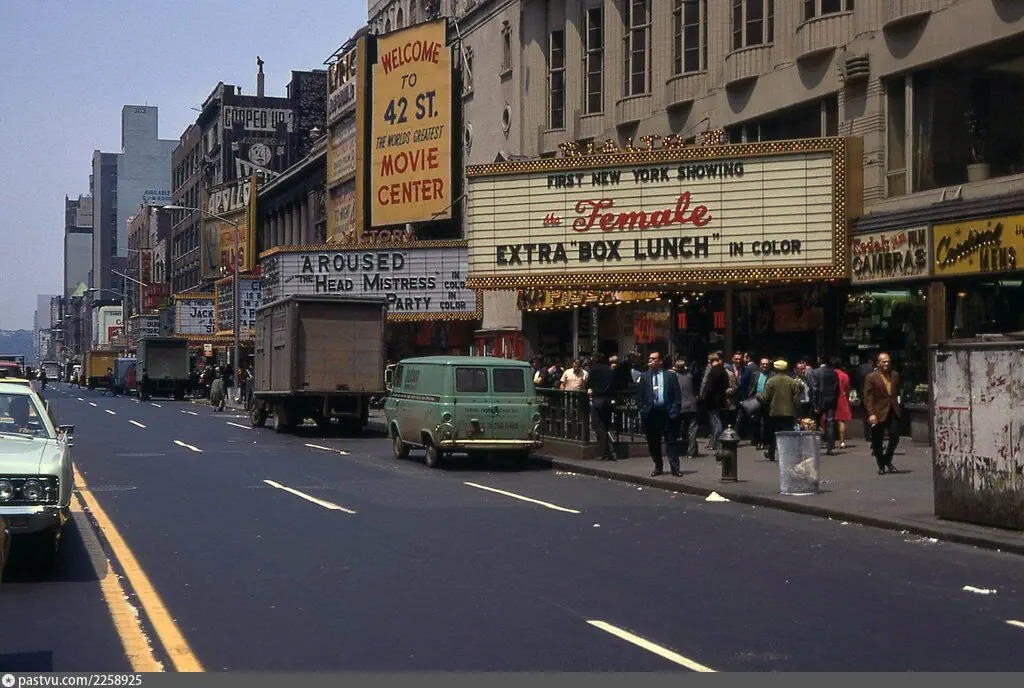
42nd Street (1969)
Adult entertainment advertisements on 42nd Street including "Aroused Female" and "Extra Box Lunch" film posters.
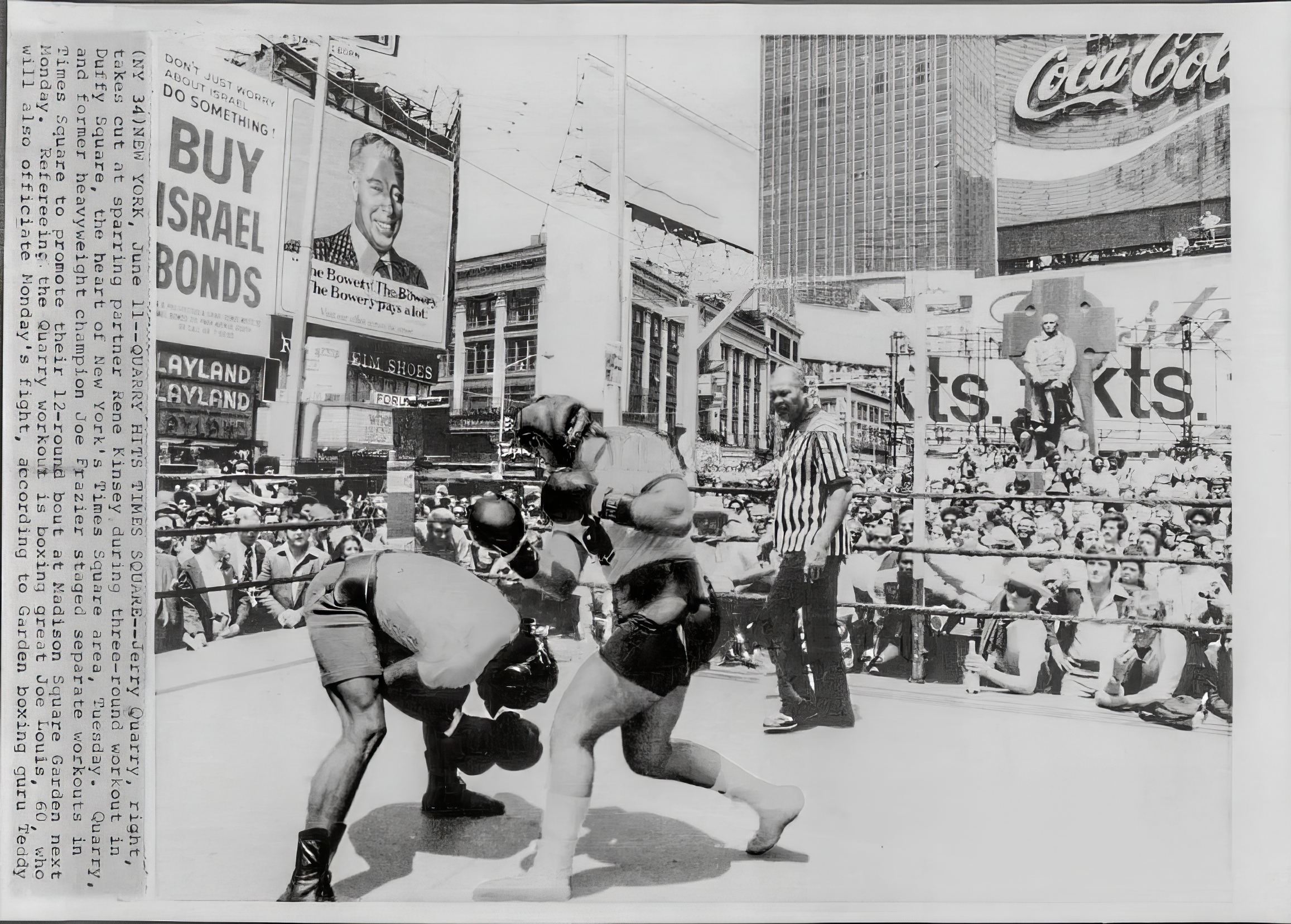
Boxing in "Duffy Square Garden" (1969)
In preparation for the 1969 World Heavyweight title, Joe Frazier and Jerry Quarry sparred in a temporary ring in the center of Times Square.
1970s
This decade saw Times Square reach its nadir, with rampant crime, pornography, and prostitution defining the area. The area became known for its peep shows, adult movie theaters, and sex shops, earning a reputation as a dangerous and seedy part of New York City. Despite the decline, cultural institutions like Studio 54 (just off Times Square) attracted celebrities and maintained a connection to the area's entertainment heritage. In 1975, the iconic TKTS booth opened, selling discounted Broadway tickets and providing a rare bright spot during this difficult period.
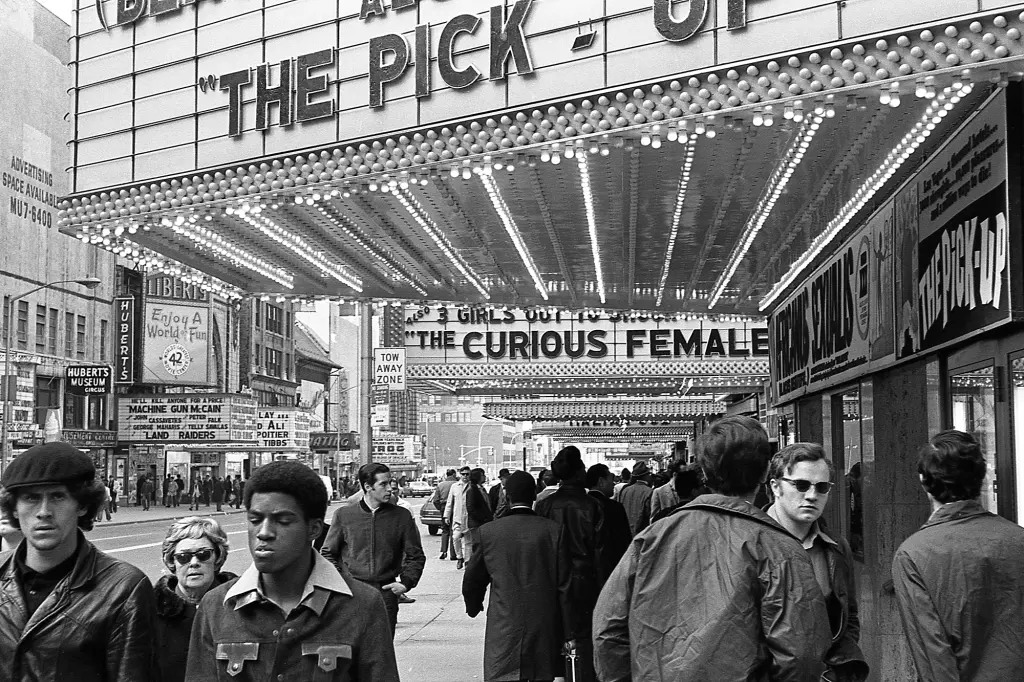
42nd Street (1970)
Movies playing in 1970 at Times Square: "The Pick Up," "Curious Female," "Trog."
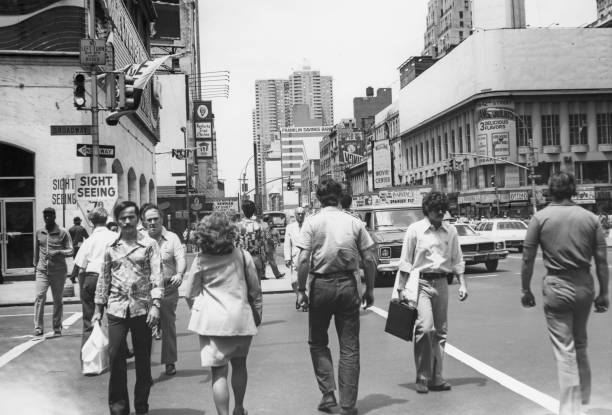
42nd Street and Broadway (1977)
View down 42nd Street showing sightseeing crowds. Photo by Peter Keegan/Keystone/Hulton Archive/Getty Images.
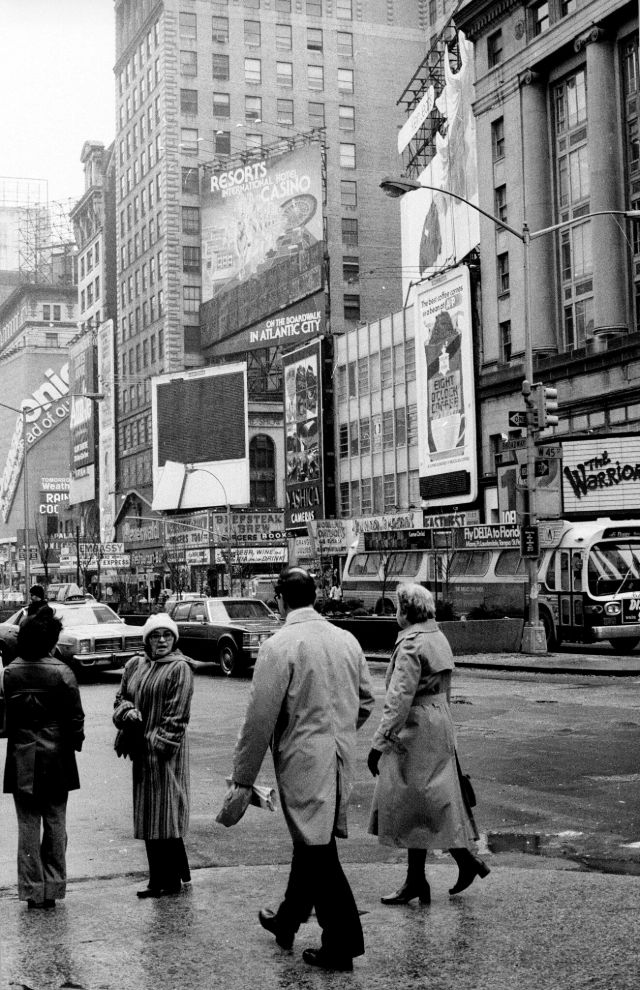
The Warriors billboard (circa 1979)
View of "The Warriors" film billboard at Loew's State Theatre.
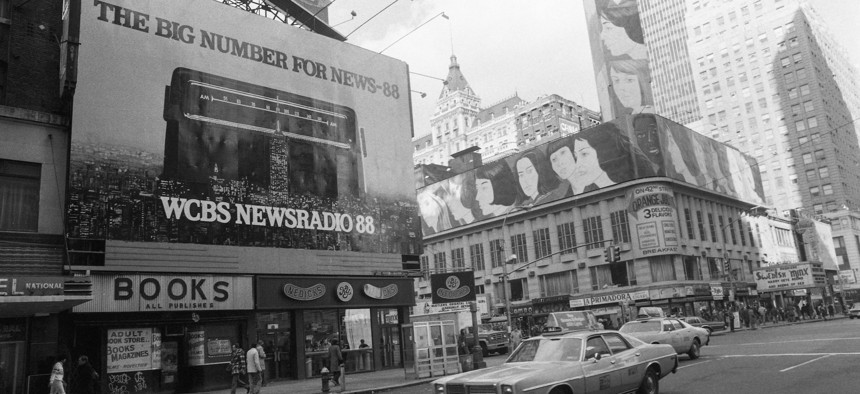
7th Avenue and 42nd Street (1979)
Francois Lochon photograph featuring National Hotel, Rialto Theatre, and WCBS Newsradio 88 billboard.
1980s
The first serious efforts to revitalize Times Square began in the 1980s under Mayor Ed Koch. The 42nd Street Development Project was launched in 1981, aiming to clean up the area and attract legitimate businesses back to Times Square. The Marriott Marquis hotel opened in 1985, representing one of the first major new developments in the revitalization effort. Despite these efforts, Times Square continued to struggle with crime and negative perceptions throughout most of the decade.
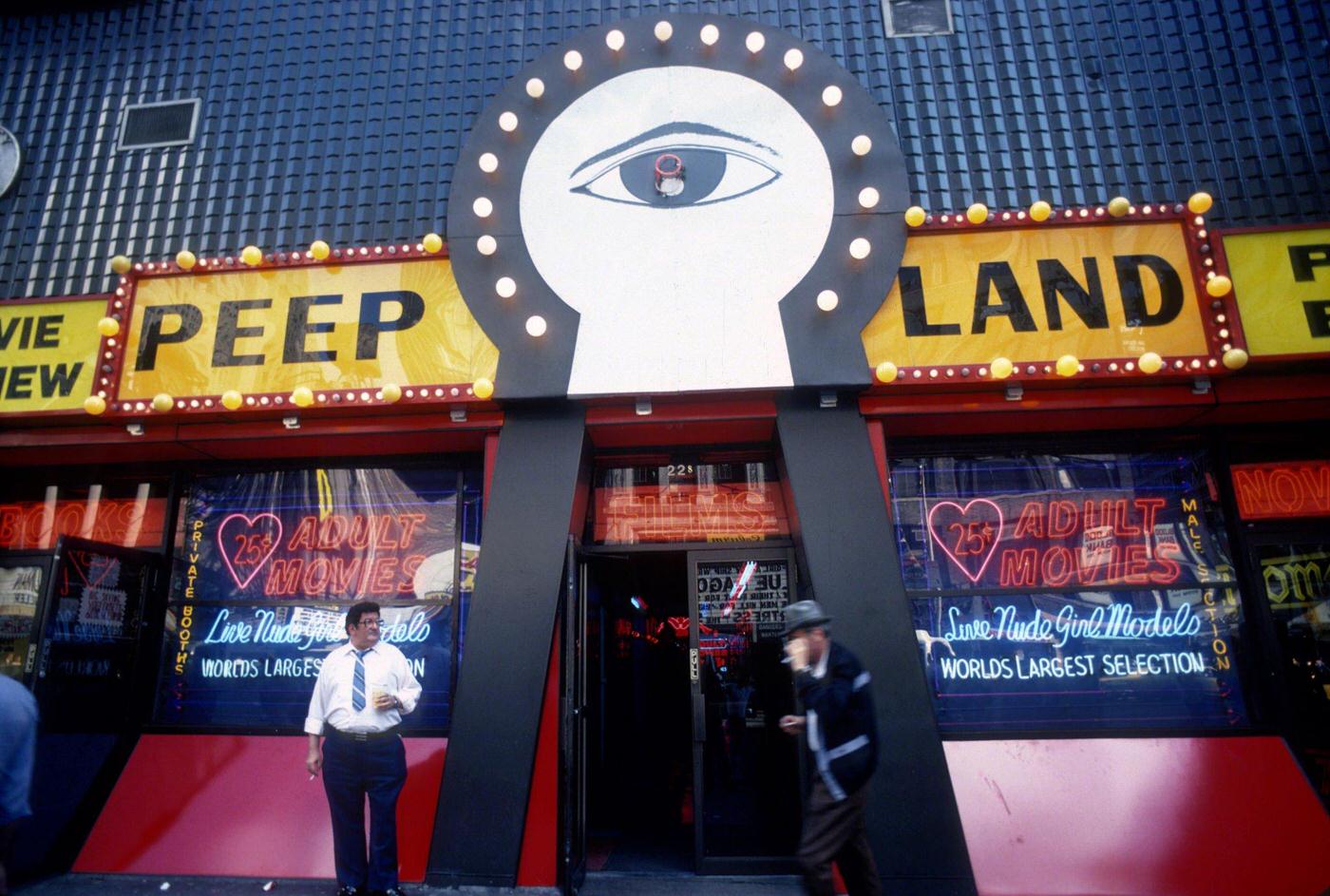
Peepland (1980)
Peepland adult entertainment venue at 228 W 42nd St, former site of Murray's Roman Gardens.

Times Square (1981)
View of "the Stack" with Midori and Coca-Cola billboards, before the 1982 Broadway "massacre" that demolished Victoria Theatre.
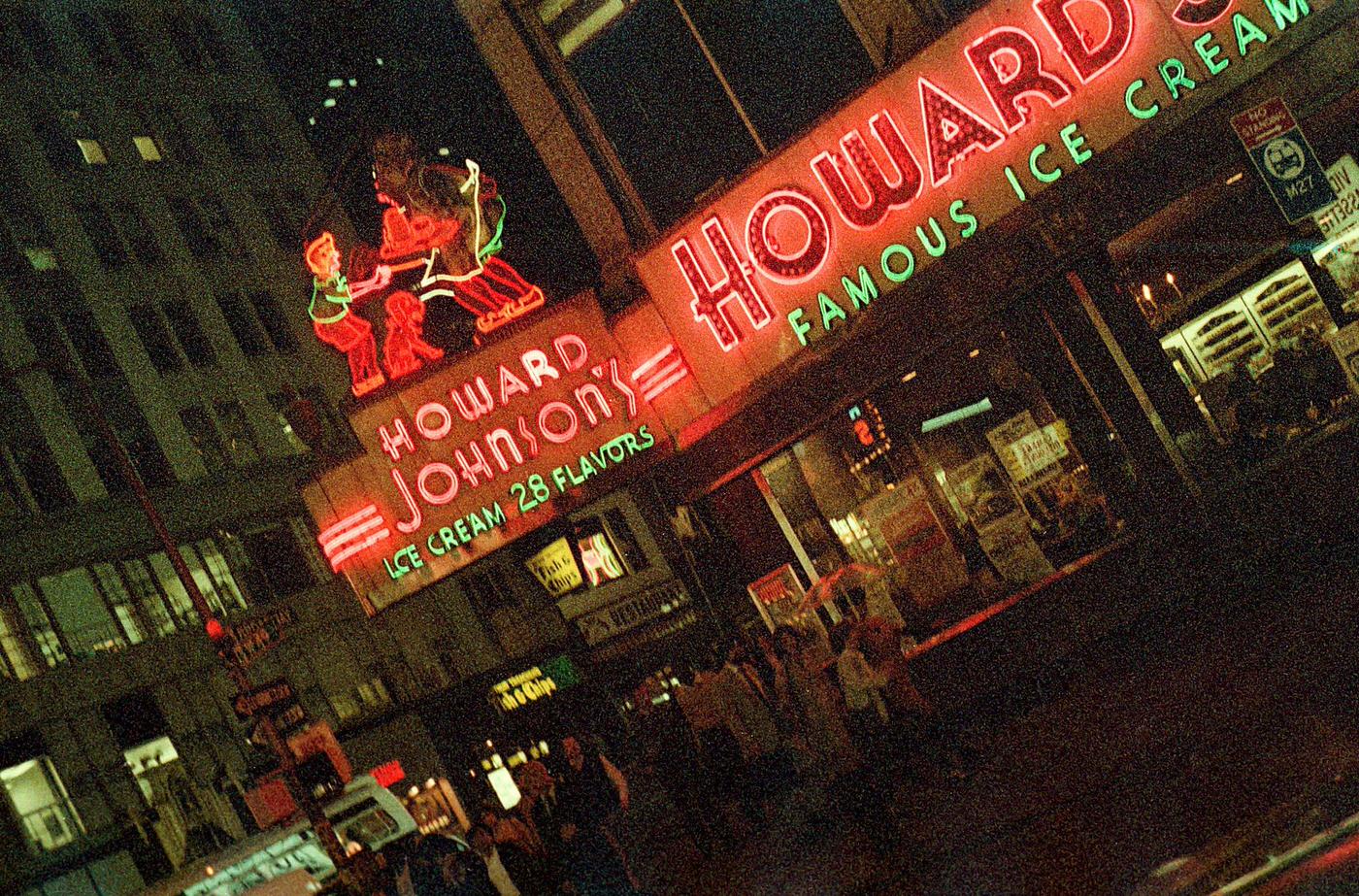
Howard Johnson's (1984)
Howard Johnson's restaurant at Broadway and 49th St, featuring the iconic Simple Simon neon sign.
1990s
Under Mayor Rudolph Giuliani, the transformation of Times Square accelerated dramatically. The "Disneyfication" of Times Square began when the New Amsterdam Theatre was restored by Disney and reopened in 1997 with "The Lion King." Zoning changes implemented in the 1990s required buildings to have illuminated signage, preserving the area's characteristic bright lights. Major corporations like Madame Tussauds (2000), Toys "R" Us (1999), and Virgin Megastore moved into the area, changing its character from adult entertainment to family-friendly tourist destination. The New Year's Eve celebration grew into a global media event, broadcast worldwide.
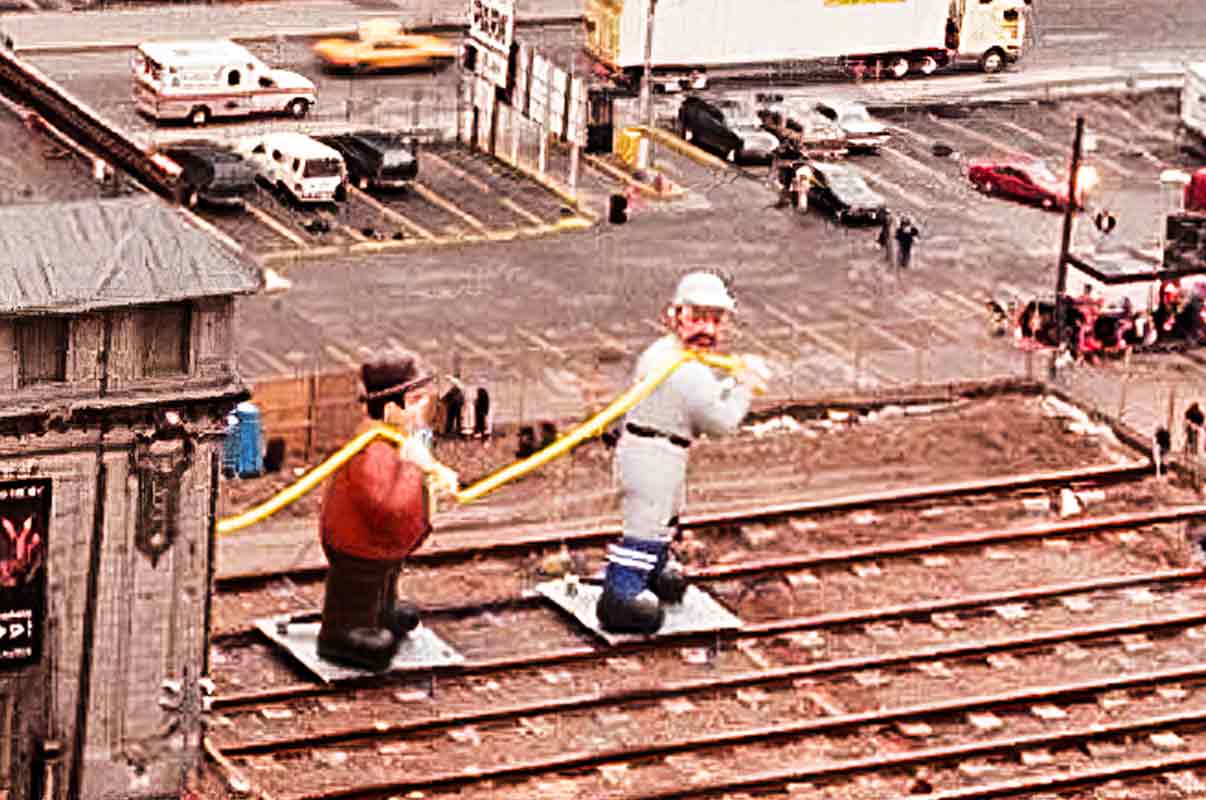
Empire Theatre Move (1998)
Giant Abbott & Costello balloons help pull the Empire Theatre 168 feet west down 42nd Street.
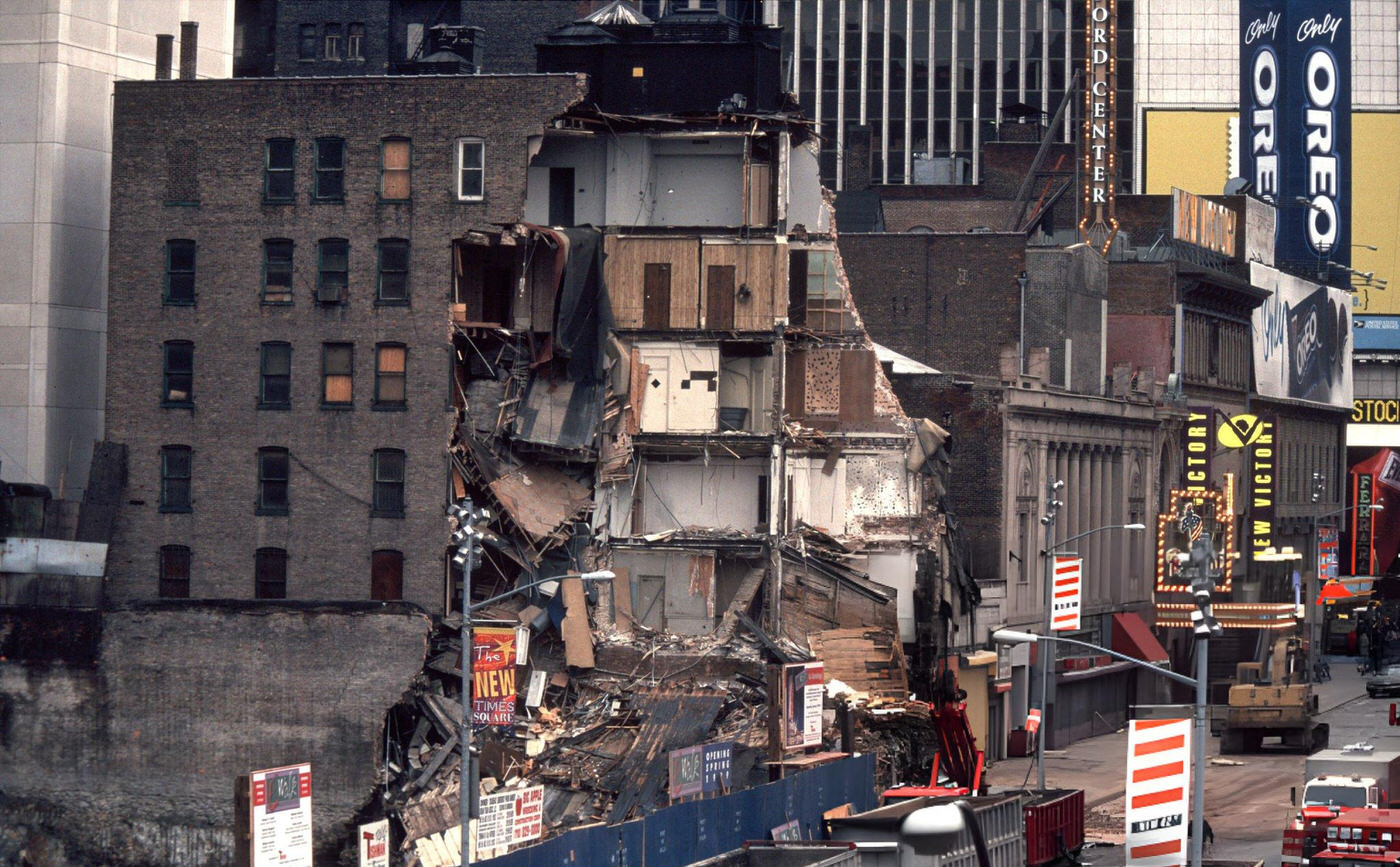
42nd St. Knockdown (1997)
Demolition clears 42nd Street as the Giuliani-era redevelopment of Times Square accelerates.
2000s
The revitalization of Times Square was fully realized in the 2000s, with the area becoming one of the world's top tourist destinations.
In 2002, the famous Toys "R" Us store with its indoor Ferris wheel opened, becoming a major attraction.
The Reuters Building was completed in 2001, adding to the modern skyline.
In 2009, Mayor Michael Bloomberg closed parts of Broadway to vehicular traffic, creating pedestrian plazas that transformed how people experienced Times Square.
Digital billboards and LED screens became increasingly dominant in the Times Square landscape.
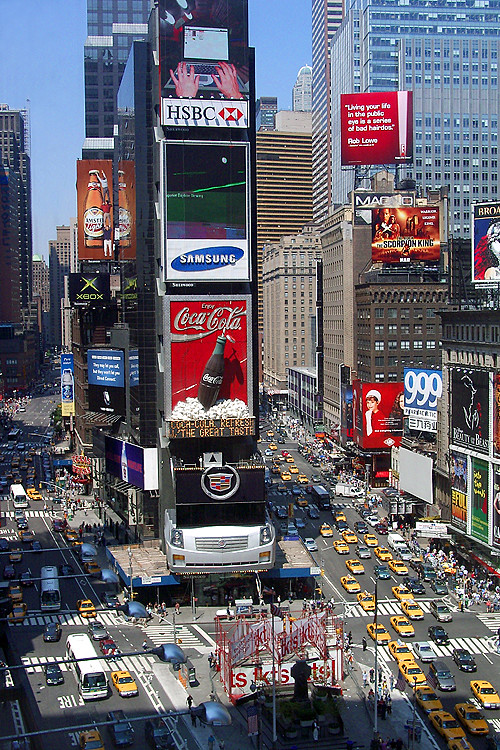
Times Square (2002)
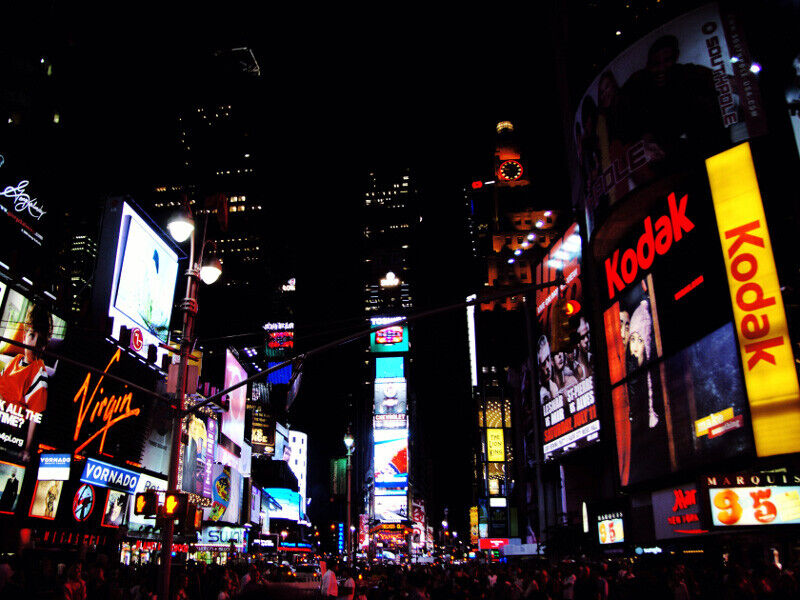
Times Square at Night (2009)
2010s
Times Square continued to evolve as a global tourist destination and commercial center. In 2011, over 40 million tourists visited Times Square, cementing its status as one of the world's most visited places. The TKTS booth was redesigned with its iconic red steps, becoming a popular meeting spot and viewpoint. In 2017, the New Year's Eve Ball was upgraded with 2,688 Waterford Crystal triangles and 32,256 LEDs, creating a more spectacular light show.
Regulations were implemented to control "costume characters" who posed for photos with tourists.
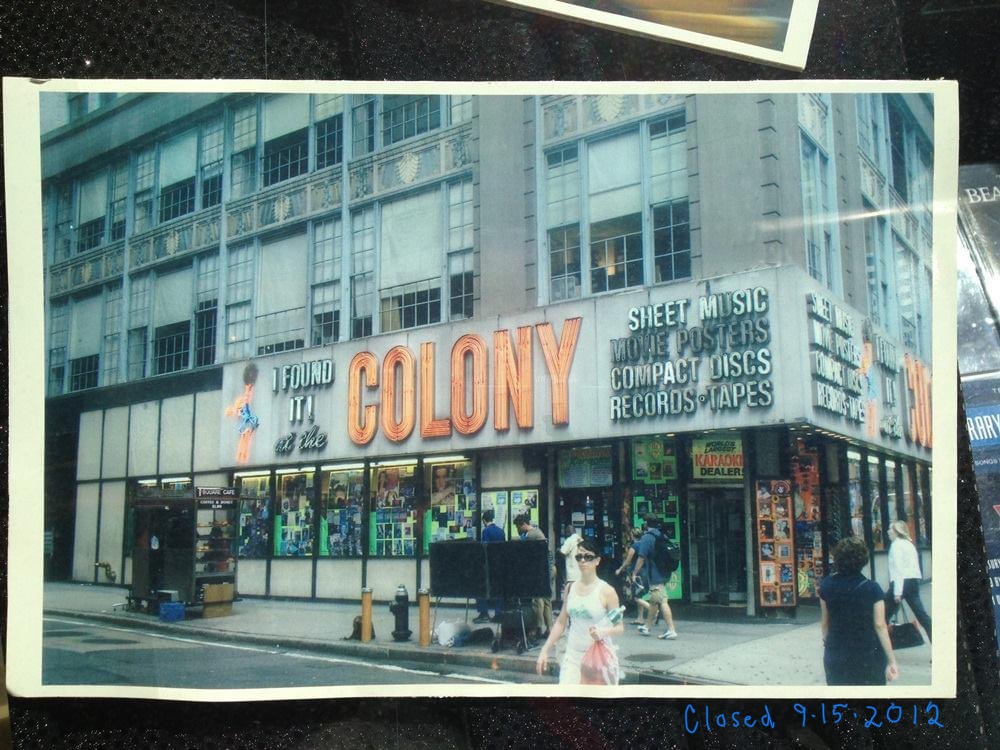
Colony Records (2011)
Additional Links
These links provide further information about Times Square's history and significance:
- Times Square in Film - Explore how Times Square has been featured in movies throughout history
- Times Square Alliance - Official website for the Times Square Alliance, which works to improve and promote Times Square
- NYC Go - Times Square - Official tourism information about Times Square
- New York Public Library - History of Times Square - Historical information and photographs
- The Broadway League - Information about Broadway theaters and productions
- The New York Times - Times Square History - Historical articles and photos from the newspaper that gave Times Square its name
- Times Square Museum and Visitor Center - Resources about the history and evolution of Times Square
- The New 42nd Street - Information about the 42nd Street Development Project
- Columbia University Libraries — Seymour B. Durst Old York Collection - Avery Architectural & Fine Arts Library digital archive of New York postcards, photographs, and ephemera
- Times Square Live Camera — 1540 Broadway - Live feed from the American Eagle LED billboard; streaming since July 2023
- Village Preservation — Jenny Holzer Truisms at Times Square Theater - Documents the Holzer marquee installation on 42nd Street
- Another Eye Opens — Jenny Holzer's Marquees (photo diary) - Deep-archive photos of Holzer's Times Square theater marquee installations
- Penumbra Foundation — Andrew Moore, Empire Portfolio - Limited edition photographs made inside the defunct 42nd Street theaters, winter 1995–96
- Sign & Billboard Blog — Bond Clothing Store Signs in Times Square - History and photos of the iconic Bond Clothing Store signs that dominated Times Square
Sources
This timeline and information about Times Square has been compiled from various historical sources, including:
- New York Historical Society — digital archives and photographic collections
- The New York Times — historical archives via TimesMachine
- Times Square Alliance — historical documentation
- The Broadway League — historical records
- Broadway: The American Musical — PBS documentary series
- Times Square Spectacular: Lighting Up Broadway — Darcy Tell
- On Broadway: A Journey Uptown Over Time — David W. Dunlap
- The Devil's Playground: A Century of Pleasure and Profit in Times Square — James Traub
- On the Town: One Hundred Years of Spectacle in Times Square — Marshall Berman
- New York in the Forties — Andreas Feininger, ed. John von Hartz
- Old New York in Early Photographs, 1853–1901 — 196 prints from the collection of the New-York Historical Society
- Museum of the City of New York — online collections portal
- Library of Congress — Prints & Photographs Online Catalog
- Al Ponte's Time Machine — New York historical photograph collection
- Getty Images — archive
- Personal photography collections including works by Anthony Lanza, Samuel H. Gottscho, Francois Lochon, and others
(Additional sources and citations have been included based on the timeline information and may require further verification.)