Featured Piece · The Classical World · Roman wall painting, before 79 CE
The Nile imagined at Pompeii
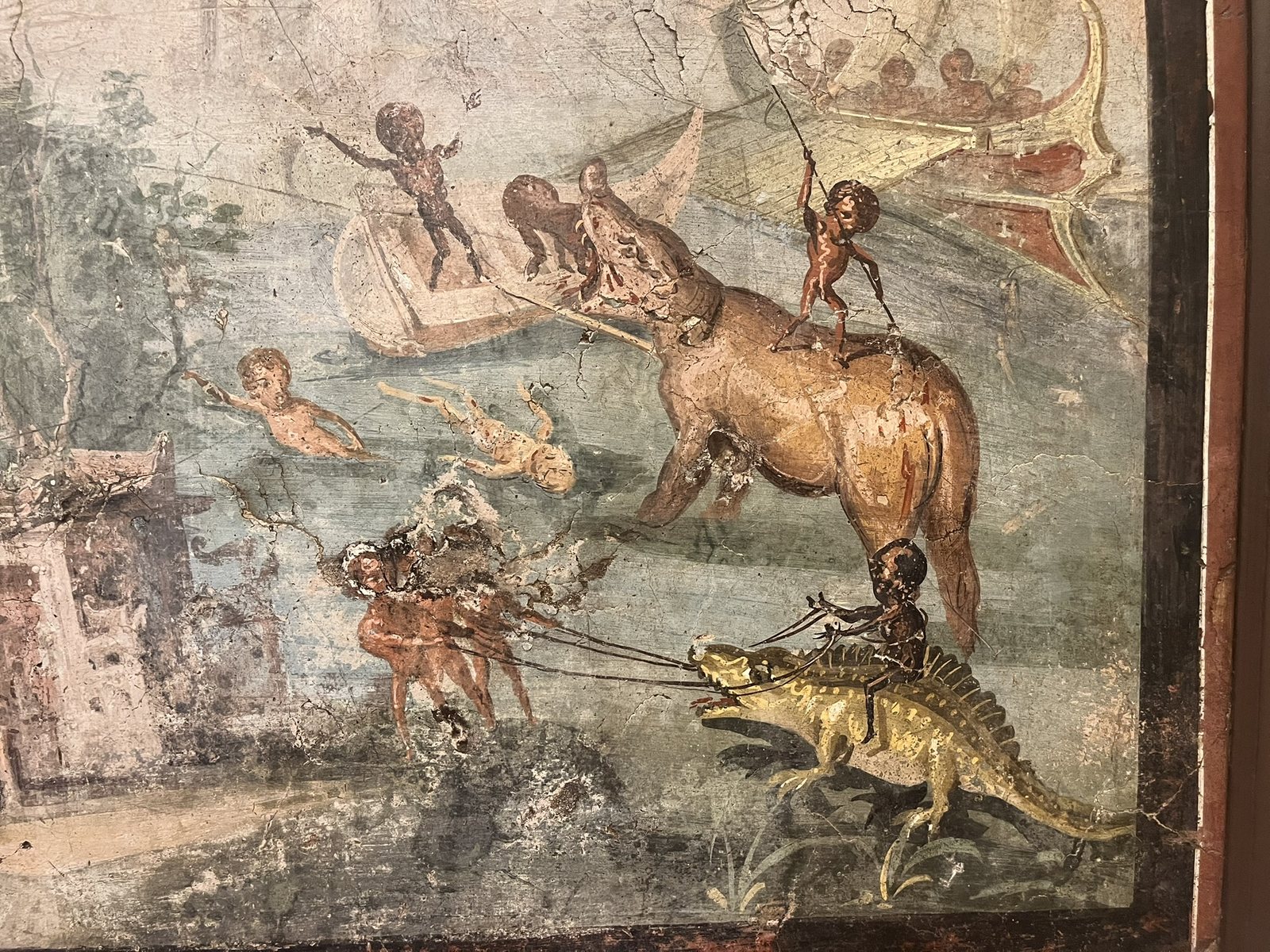
A hippopotamus looms over a boat; below it, a crocodile carries a tiny rider. The animals are real, but their encounters belong to a painted world of danger, comedy and exaggeration. This is Egypt as imagined on a Roman household wall—not a wildlife documentary.
The work: Scene on the Nile, a Fourth Style fresco from the peristyle of the House of the Doctor (VIII.5.24), Pompeii. Now in the Museo Archeologico Nazionale di Napoli, inventory 113195. The photographed book caption gives 75 × 127 cm. The eruption of 79 CE is a latest possible date, not a claimed year of creation.
Detail photographed by DiLo at the Naples archaeological museum. The complete fresco extends beyond this photograph. Select a number to explore the scene, or the photograph to enlarge it.
The beasts—and people—within
1 · Hippopotamus
The enormous open mouth and heavy body identify a hippo, not the elephant named in one reproduction seller’s title. A person stands on its back while a boat and its occupants are caught in the encounter. A real river animal becomes the scene’s outsized menace.
2 · Crocodile
The long jaws and armored back are unmistakable. The rider appears to hold lines toward its mouth: a dangerous animal treated almost as a mount. That visual absurdity is part of the scene’s unsettling humor.
3 · Human figures
Older catalogues call these figures “pygmies.” In this artistic tradition, the term refers to exaggerated, small-statured figures associated with Greek myth—not a reliable portrait of a living African community. Here the humans, rather than the animals, receive the most fanciful treatment.
A Roman room with an imagined Egyptian view
“Nilotic” simply means relating to the Nile. Roman painters and mosaic makers used its river life to create distant, marvelous settings. Such scenes could suggest abundance, danger, comedy or an owner’s familiarity with the wider world. Their meanings varied with their setting; no single explanation accounts for every Nile landscape.
This fresco belonged to a house’s peristyle—a courtyard bordered by columns. The photographed book places small landscape scenes within the larger decorative arrangements of Pompeian rooms. The painting was part of an environment, not originally an isolated museum picture.
Connections worth following
Real beasts, fantastic storytelling: this is a useful counterpoint to the bestiary’s hybrids. A creature need not be imaginary for an artist to give it an extraordinary role.
Egypt and the Sphinx: tiny roof figures in the complete fresco may be sphinx-like, but this detail photograph does not show them clearly enough to identify. Compare the Sphinx (Human-headed lion) for the hybrid tradition; this is a thematic connection, not a confirmed identification of the roof figures.
Sources, interpretation & what remains to check
Object identification: photographed book caption, IMG_8038; narrative discussion, IMG_8053, p. 83. Book title, author and edition still need identification. These photographs are research evidence, not reproduced illustrations here.
Separate works: the marine-life mosaics photographed in the same folder are not this fresco. One caption names House VIII.2.16; another names the House of the Faun. They remain separate research leads.
Next research: confirm a narrower creation date, identify the book, assess the tiny roof figures, and prepare a companion TimeSync entry. Public image-reuse requirements remain a separate check; this update is local only.